2025–2026 Digital Reading Journal KDP
Reading remains one of the most powerful tools for learning, reflection, and growth—but how we track, process, and return to what we read is changing fast. The 2025–2026 Digital Reading Journal KDP reflects that shift: a thoughtfully structured, production-ready interior designed not just for readers, but for creators who understand that clarity, consistency, and compatibility matter more than ever.
A Practical Response to Evolving Reading Habits
Today’s readers—whether educators preparing lesson notes, entrepreneurs capturing insights from business books, or freelancers building knowledge banks—are less likely to rely on static notebooks or fragmented digital notes. Instead, they seek systems that bridge intention and action: journals that support annotation, synthesis, and review without friction. The 2025–2026 Digital Reading Journal KDP meets this need with purpose-built structure—not as a generic planner, but as a reading-specific framework tested across real-world use cases.
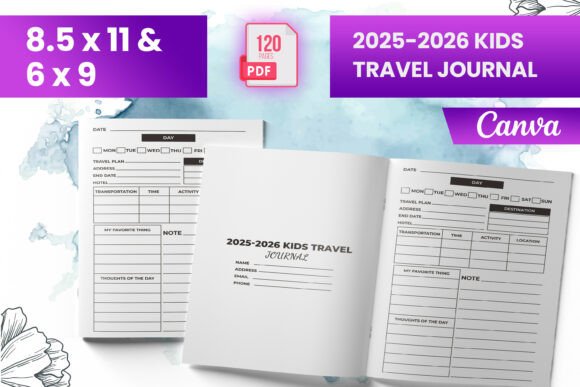
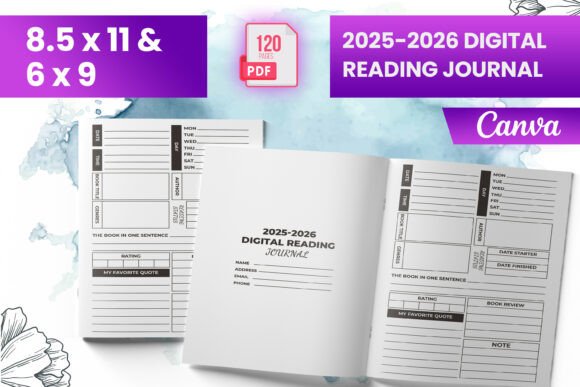
What sets it apart isn’t novelty for its own sake, but refinement grounded in observed behavior. For example, users increasingly prefer journals with intentional whitespace—not empty pages, but breathing room between prompts that invite deeper processing. This version includes 120 total pages, each calibrated for usability: enough space for meaningful reflection, yet concise enough to sustain momentum over time. The intro page serves as both orientation and invitation—helping users clarify their reading goals before turning to the first entry.
Designed for Creators Who Ship—Not Just Sketch
If you’re publishing on Amazon KDP, speed and reliability aren’t optional. They’re prerequisites. That’s why this interior delivers a ready-to-upload PDF file—no reformatting, no guesswork. Every dimension (6″ × 9″, 8.5″ × 11″, and other standard KDP sizes) has been validated against current KDP guidelines, including bleed requirements. Files were tested directly on Kindle Direct Publishing to confirm margins, image resolution, and color fidelity—so your journal arrives print-ready, not “almost ready.”
This isn’t theoretical optimization. It’s workflow-aware design. Consider a freelance content strategist launching a niche reading journal series: she needs to move from concept to live listing in under 48 hours. With PNG and JPG assets included alongside the main PDF, she can easily adapt cover mockups, create social previews, or build Canva-based promotional visuals—without waiting for a designer or wrestling with export settings.
Why Format Flexibility Matters Now More Than Ever
Readers today consume across devices, formats, and contexts—audiobooks during commutes, PDFs on tablets, physical copies for deep focus. A journal that only works in one context quickly becomes obsolete. The 2025–2026 Digital Reading Journal KDP anticipates this by supporting multiple trim sizes without sacrificing layout integrity. Whether a user prefers the portability of 6″ × 9″ or the spaciousness of 8.5″ × 11″, the interior maintains consistent spacing, typography hierarchy, and prompt placement.
This flexibility also matters for creators experimenting with audience segmentation. An educator might offer the same journal in two sizes—one optimized for classroom handouts (8.5″ × 11″), another for student-owned personal copies (6″ × 9″). Because the files are pre-tested and bleed-ready, scaling across variants adds minutes—not days—to production time.
Real-World Use Across Professions
The value of a well-structured reading journal reveals itself most clearly in daily practice—not abstract theory. Here’s how professionals are applying versions like the 2025–2026 Digital Reading Journal KDP:
- Bloggers and newsletter writers use the prompt-based entries to extract quotable insights, summarize arguments, and tag themes for future content—turning passive reading into active research.
- Small business owners apply the reflection sections after leadership or strategy books, connecting concepts to quarterly planning cycles rather than letting ideas fade after the final chapter.
- Educators adapt the intro page and recurring prompts to model metacognitive habits for students—showing *how* to think about reading, not just *what* was read.
- Freelance designers and marketers treat the included PNG and JPG files as modular assets—reusing icons, section dividers, or typography treatments across client projects or personal brand materials.
None of these uses require technical expertise. They rely instead on thoughtful scaffolding—structure that supports, not constrains.
Technology Is Enabling, Not Replacing, Intentional Practice
It’s easy to assume digital tools must mean apps, cloud sync, or AI summaries. But for many readers—especially those managing attention across multiple platforms—the most reliable tech is still a well-designed PDF. The 2025–2026 Digital Reading Journal KDP embraces that reality. It doesn’t try to replicate Notion or Obsidian. Instead, it leverages the stability of print-optimized PDFs while retaining digital adaptability: highlightable text, searchable keywords, and compatibility with PDF annotation tools on tablets or laptops.
This approach aligns with a broader trend: selective digitization. People aren’t abandoning analog; they’re choosing where digital adds value—and where simplicity wins. A clean, bleed-ready interior means fewer variables when printing at home or through third-party services. No font substitution errors. No unexpected line breaks. Just consistent, predictable output.
What You Get—And Why Each Element Serves a Purpose
The package includes more than files—it includes confidence in execution. Let’s break down what’s included and why it matters:
- Ready-to-upload PDF file: Eliminates formatting risk. You upload and publish—no last-minute troubleshooting.
- Multiple trim sizes (6″ × 9″, 8.5″ × 11″, and others): Lets you test audience preference or expand into new categories without redesigning from scratch.
- 120 total pages: Balances depth with sustainability—enough for 30–40 substantial reads, but not so long it feels daunting to begin.
- Intro page: Anchors the experience. Helps users define purpose before diving in—critical for habit formation.
- Files tested on Amazon KDP: Confirms bleed alignment, CMYK readiness, and margin safety—avoiding common rejection reasons.
- PNG and JPG files: Enable quick visual customization—ideal for A/B testing covers, building email banners, or adapting layouts in Canva without starting from zero.
Notice what’s missing: bloated feature lists, vague promises, or “AI-powered” labels that don’t translate to daily use. This is infrastructure—not hype.
Looking Ahead—Without Overpromising
As we move deeper into 2025 and toward 2026, expectations around self-directed learning continue to rise—not because people read more, but because they expect more from what they read. Skimming won’t suffice when information density increases and attention fragments further. Journals that support synthesis, connection-making, and recall become practical necessities, not nice-to-haves.
The 2025–2026 Digital Reading Journal KDP doesn’t claim to solve distraction or guarantee retention. What it does offer is a proven, adaptable container for the work that follows reading: clarifying takeaways, identifying applications, and building personal knowledge systems—one intentional entry at a time.
For creators, it removes friction from publishing. For readers, it removes ambiguity from engagement. And for both, it reflects a simple truth gaining quiet momentum: the most effective tools aren’t the flashiest—they’re the ones you actually use, consistently, without resistance.