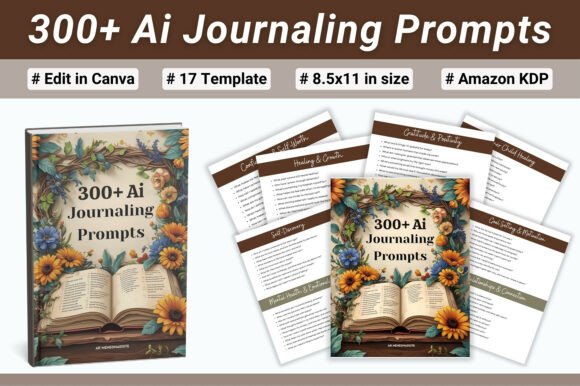
300 AI Journaling Prompts
What if your journal wasn’t just a place to record the day—but a trusted companion for clarity, healing, and growth? That’s exactly what 🧠✨ 300 AI Journaling Prompts delivers: a thoughtfully engineered collection designed not to overwhelm, but to invite. These aren’t generic questions scraped from a trend list. Each prompt is AI-curated with intention—grounded in cognitive psychology, mindfulness practice, and narrative therapy principles—to spark honest reflection without pressure or performance.
More Than Just Questions—A Framework for Inner Work
The strength of 🧠✨ 300 AI Journaling Prompts lies in its architecture. Rather than dumping 300 prompts into one undifferentiated list, it organizes them across 30 life-affirming themes—from “Emotional Boundaries” and “Creative Re-ignition” to “Career Alignment” and “Grief Integration.” Each theme contains 10 tightly written, non-repetitive prompts that build in depth: starting with observation (“What emotion showed up most this week—and where did you feel it in your body?”), moving into interpretation (“When have you felt this way before? What pattern do you notice?”), and ending with agency (“What small boundary could honor this feeling tomorrow?”).
This layered structure makes the resource unusually adaptable. A therapist might assign the “Self-Compassion” set to clients between sessions. A marketing director could use the “Decision Fatigue” prompts during quarterly planning to surface unspoken trade-offs. A high school English teacher might adapt the “Story Identity” section for student-led reflective writing—no prep time needed.
Designed for Real Life—Not Just Idealized Routines
Let’s be honest: most journaling resources assume you’ll sit quietly with tea at dawn. 🧠✨ 300 AI Journaling Prompts respects how people actually live. The prompts work in 5-minute bursts (try one before a Zoom call) or as deep-dive weekly reflections. They’re equally effective typed into a Notes app, scribbled in a Moleskine, or pasted into a Canva template for visual journaling.
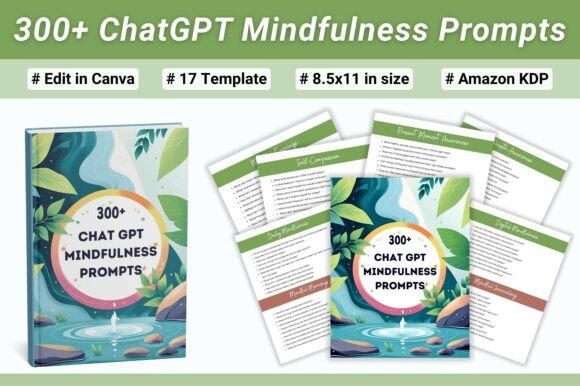
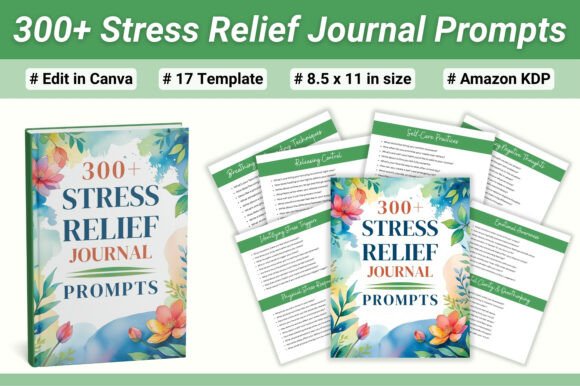
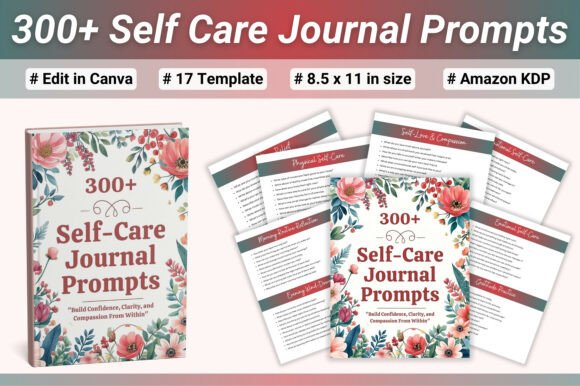
The included 17-page Canva template isn’t decorative fluff—it’s functional design. Each layout uses intentional white space, subtle typography hierarchy, and optional checkboxes or rating scales—so users can track mood shifts, habit consistency, or goal progress *without* adding administrative overhead. The PDF is print-ready at 300 dpi, meaning it looks crisp whether you’re printing at home on recycled paper or ordering a spiral-bound version from a local print shop.
Where This Resource Earns Its Keep
- For creators and solopreneurs: Use the “Creative Blocks” and “Authentic Voice” prompts to break through imposter syndrome before drafting content—or to refine your brand messaging by asking, “What do I want my audience to *feel*, not just know, after reading this?”
- For educators and coaches: Pull individual prompts for group warm-ups, breakout reflection, or asynchronous discussion boards. No need to credit—the license permits commercial and classroom use.
- For HR and team leads: Integrate prompts like “What does psychological safety sound like in our meetings?” or “When did I last speak up—and what made that possible?” into team retrospectives. It surfaces culture insights faster than traditional surveys.
- For therapists and wellness practitioners: The “Shadow Work” and “Healing Timelines” sections offer clinically adjacent language—gentle, non-pathologizing, and rich with somatic hooks—making them safe for clients navigating complex emotions.
Why “AI-Curated” Actually Matters Here
AI isn’t used as a shortcut—it’s leveraged as a precision tool. Human editors trained the model on decades of therapeutic frameworks (ACT, DBT, narrative therapy), then refined outputs to eliminate vague phrasing (“What makes you happy?”), leading questions (“Don’t you feel better now?”), or culturally narrow assumptions. The result? Prompts like “What’s one thing your nervous system has been trying to tell you this month—and how might you listen differently next week?” That specificity builds trust. It signals: *I see your complexity. You don’t need to explain yourself first.*
Practical Considerations Before You Begin
While 🧠✨ 300 AI Journaling Prompts is exceptionally versatile, its impact depends on how you engage with it—not just download it. Start small: pick *one* theme that feels quietly urgent (not the “most productive” one). Try three prompts over five days. Notice which ones create pause, discomfort, or unexpected relief. Skip the rest. There’s no requirement to “finish” anything.
Also worth noting: the digital files include transparent PNGs and high-res JPGs—not just for social sharing, but for embedding into newsletters, Notion dashboards, or internal wikis. One freelance writer told us she drops a different prompt into her client onboarding email each month. It’s become a quiet signature—a way to signal depth before the first call even happens.
A Tool That Grows With You
Unlike static workbooks that lose relevance after a few weeks, 🧠✨ 300 AI Journaling Prompts reveals new layers over time. A prompt you skimmed past in January might land like a revelation in August—after a promotion, a loss, or a shift in values. That’s by design. The prompts avoid prescriptive answers; instead, they hold space for evolving truths. They don’t ask “What’s your passion?”—they ask “When did you last lose track of time doing something small? What was present in that moment?” That kind of question stays useful across decades.
If you’ve ever stared at a blank page wondering where to begin—or abandoned journaling because it started to feel like another task—this collection meets you there. Not with more discipline, but with better invitations. Invitations that remember you’re human: inconsistent, curious, resilient, and worthy of your own attention—even in fragments.