300 Self Care Journal Prompts
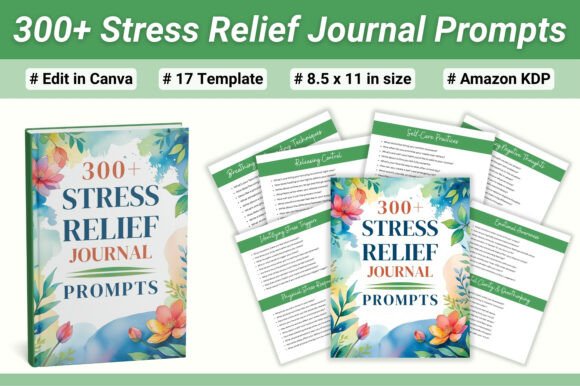
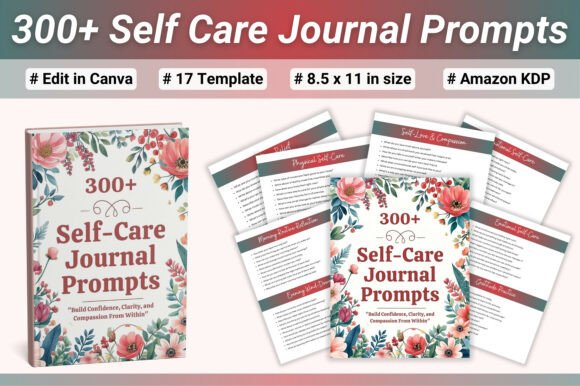
🌸 300 Self Care Journal Prompts is a digital journaling resource designed to support consistent, intentional self-reflection across physical, mental, emotional, and creative dimensions. It consists of 300 thoughtfully curated prompts organized into six thematic categories: Morning and Evening Routines, Mental Clarity, Emotional Healing, Mind-Body Connection, Creative Expression, and Gratitude Practice. Delivered as an instant digital download, it includes a 17-page Canva-editable template, a print-ready PDF (US Letter, 300 dpi, no bleed), high-resolution JPG and transparent PNG files — all optimized for home or professional printing.
Why People Explore This Resource
Individuals often seek journaling tools when they notice recurring patterns — difficulty unwinding at night, trouble identifying emotional triggers, inconsistent routines, or a sense of disconnection from their own needs. Unlike generic journaling apps or blank notebooks, 🌸 300 Self Care Journal Prompts offers structure without rigidity. It’s commonly evaluated by people who value guided reflection but want flexibility in how and when they engage — whether through handwriting, digital annotation, or creative adaptation using the Canva template.
Practical Benefits
The primary benefit lies in accessibility and scope. With 300 prompts distributed across distinct wellness domains, users can rotate focus based on current needs — for example, leaning into Emotional Healing prompts during periods of transition, or returning to Morning Routines when seeking stability. The inclusion of both time-based (morning/evening) and process-based (gratitude, creativity) categories supports layered self-awareness over time.
The file formats add functional versatility. The Canva template allows customization of fonts, colors, and layout — useful for neurodivergent users who benefit from visual consistency or sensory-friendly design. The print-ready PDF ensures legibility and fidelity for handwritten use, while the high-resolution image files accommodate planners, bullet journals, or digital note-taking apps that accept JPG or PNG backgrounds.
Tradeoffs and Considerations
This resource does not include instructional content, audio guidance, or progress tracking features. It assumes users already understand basic journaling principles — such as writing freely without editing, maintaining privacy, or recognizing when a prompt feels unhelpful. Those new to reflective practice may benefit from pairing it with introductory resources on journaling fundamentals before diving in.
Because it’s a static digital product, it doesn’t adapt to user input or offer personalized recommendations. A prompt that resonates deeply one week may feel irrelevant the next — and that’s expected. Consistent value comes from regular engagement and willingness to skip or reinterpret prompts rather than treat them as prescriptive tasks.
It also requires self-direction. There’s no built-in accountability, scheduling, or reminders. Users who rely on external cues (e.g., app notifications, group check-ins) may need to layer in their own systems — like setting a weekly calendar alert or assigning prompts to specific days — to sustain use.
When It’s a Strong Fit
🌸 300 Self Care Journal Prompts is especially well-suited for individuals who:
- Already journal occasionally but struggle with prompt fatigue or repetition;
- Prefer tangible, customizable tools over subscription-based apps;
- Want to deepen attention to holistic self-care — not just mood or productivity — without committing to clinical or therapeutic frameworks;
- Enjoy blending modalities — for instance, sketching alongside written reflection, or pairing gratitude prompts with mindful breathing;
- Value ownership of their data and materials, preferring downloadable files they control long-term.
It also aligns well with educators, counselors, or wellness facilitators who incorporate journaling into workshops or one-on-one sessions and need adaptable, non-branded content they can modify or distribute.
When Alternatives May Be Worth Considering
If your goal is real-time feedback or behavioral nudges, dedicated journaling apps (e.g., Day One, Reflectly, or Journey) offer tagging, search, analytics, and cross-device sync — features this resource doesn’t provide. Similarly, if you’re working through acute stress, grief, or anxiety, evidence-based therapeutic journaling methods — such as cognitive restructuring exercises or trauma-informed expressive writing — may require more targeted guidance than general prompts supply.
For those prioritizing community or mentorship, structured programs (e.g., guided 30-day challenges with facilitator input or peer discussion) offer accountability and contextual interpretation that a standalone prompt list cannot replicate. And if minimalism is a priority — preferring fewer, higher-impact questions over volume — a smaller, curated set (e.g., 30–50 prompts focused specifically on boundary-setting or nervous system regulation) might reduce decision fatigue without sacrificing depth.
Making an Informed Decision
Before choosing 🌸 300 Self Care Journal Prompts, consider three practical questions:
- What’s my current journaling habit? If you write regularly but often pause due to lack of direction, this resource fills a clear gap. If you rarely journal and anticipate needing motivation, start with a shorter set or pair it with a simple habit-stacking strategy (e.g., “After my morning tea, I’ll respond to one prompt”).
- How do I prefer to engage with reflective tools? If you annotate digitally, the Canva file is valuable. If you write by hand, verify that the PDF’s line spacing and margins suit your pen and notebook size. Previewing sample pages — if available — helps assess readability and layout fit.
- What outcome am I hoping to support? Clarity about intention helps match tools to goals. For example, building routine consistency leans more on the Morning/Evening sections; exploring self-criticism may draw more from Emotional Healing prompts. Reviewing the category descriptions helps gauge alignment before purchase.
Finally, remember that prompt quantity alone doesn’t determine effectiveness. What matters most is frequency of use, openness to non-linear engagement (skipping, revisiting, adapting), and integration with existing self-care practices — whether that’s movement, rest, conversation, or silence. 🌸 300 Self Care Journal Prompts serves best as a flexible companion within a broader ecosystem of care, not a standalone solution.
Thanks so much for checking out this product. If it brings value to your journey, be sure to explore the rest of the shop for more tools to inspire mindfulness, creativity, and growth.