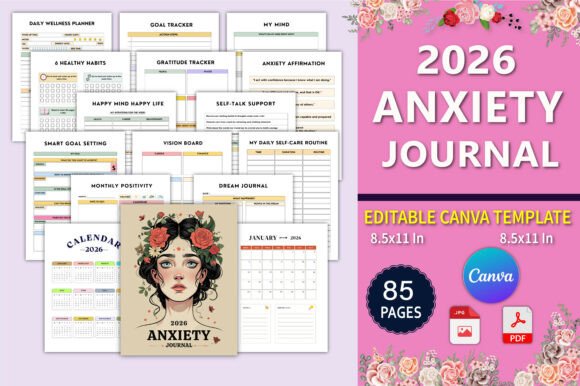
🧠 2026 Anxiety Journal: A Structured, Science-Informed Companion for Emotional Resilience
Anxiety doesn’t operate in isolation—it weaves through work deadlines, relationship dynamics, health concerns, creative blocks, and even the quiet uncertainty of long-term planning. For professionals juggling leadership responsibilities, educators supporting students’ mental wellness, creators navigating imposter syndrome, researchers managing publication pressure, or small business owners balancing growth with sustainability, anxiety often manifests not as crisis, but as chronic low-grade friction: decision fatigue, disrupted sleep, avoidance of difficult conversations, or diminished capacity for presence. The 🧠 2026 Anxiety Journal responds to this reality—not as a quick-fix tool, but as an intentional, year-long scaffold grounded in clinical psychology, behavioral science, and real-world usability.
Why Structure Matters More Than Willpower
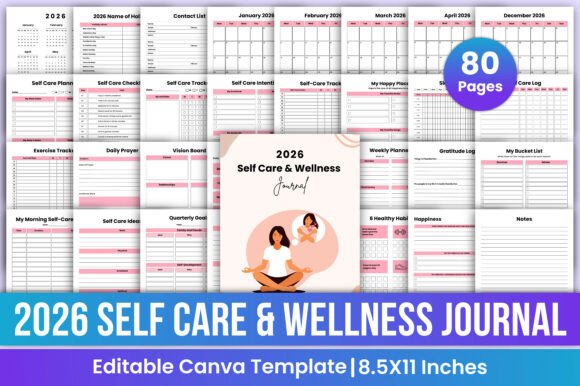
Traditional journaling advice often assumes motivation is the bottleneck. In practice, it’s structure that fails most people—not intent. Without clear entry points, consistent rhythms, or evidence-informed frameworks, even well-meaning reflection can devolve into vague venting or self-critique. The 🧠 2026 Anxiety Journal bypasses this by embedding structure directly into its architecture. Its monthly calendars aren’t decorative—they’re functional anchors for time-bound intentionality. Each month begins with a dedicated space to identify one priority emotional goal (e.g., “reduce morning cortisol spikes,” “improve boundary-setting in team meetings,” “increase restorative downtime after teaching”), then links that goal to weekly habit trackers and corresponding mood logs. This creates feedback loops: noticing a pattern of elevated anxiety on Tuesdays might prompt reviewing Tuesday’s schedule, sleep log, or self-care log—revealing correlations between back-to-back virtual classes and shallow breathing noted in the mindfulness section.
From Observation to Insight: How Tracking Builds Agency
The 🧠 2026 Anxiety Journal treats data collection not as clinical surveillance, but as compassionate self-inquiry. Its Anxiety Mood Trackers use simple, non-stigmatizing language—rating intensity on a 1–5 scale alongside brief contextual notes (“rushed commute,” “client feedback received,” “slept 5 hours”)—making patterns legible without demanding diagnostic precision. Over weeks, users consistently observe how physical sensations (tight shoulders, stomach flutter) precede cognitive spirals, or how gratitude logging correlates with improved focus during afternoon tasks. One educator using the journal noted her “low-energy” days clustered around parent-teacher conference weeks—and discovered her “wellness check-in” entries revealed she’d skipped lunch every day that week. That insight shifted her prep routine: she now batches conference prep *and* meal prep on Sundays, using the journal’s Goal-Setting Habit Trackers to reinforce the new behavior.
Guided Prompts That Move Beyond Surface Reflection
Generic prompts like “How are you feeling today?” rarely yield actionable understanding. The 🧠 2026 Anxiety Journal uses layered, clinically aligned questions designed to surface root dynamics. A single page might guide users through: (1) naming the dominant emotion *and* its physical signature, (2) identifying the earliest trigger in the preceding 24 hours (not the “biggest” stressor, but the first subtle shift), and (3) exploring one unmet need beneath the reaction (e.g., “I snapped at my colleague → felt hot/irritable → trigger was unanswered email at 7 a.m. → unmet need: predictability in communication”). This mirrors cognitive-behavioral therapy (CBT) principles while remaining accessible to non-clinical users. Business owners report using these prompts before high-stakes negotiations; researchers apply them when interpreting ambiguous peer review comments—transforming reactivity into calibrated response.
Sleep, Self-Love, and the Non-Negotiable Foundations
Wellness isn’t additive—it’s interdependent. The 🧠 2026 Anxiety Journal explicitly connects domains often siloed in other tools. Its Sleep Wellness Logs don’t just ask “hours slept”—they invite reflection on pre-sleep routines, screen exposure, evening thoughts, and morning energy levels. Paired with the Daily Mindfulness Self-Care Logs, users begin to see how skipping a 5-minute breathing exercise correlates with fragmented sleep, which then impacts next-day focus tracked in the weekly habit section. Similarly, the Self-Love Affirmation Pages avoid generic positivity. Instead, they prompt users to reframe self-critical thoughts observed in earlier journaling (“I’m falling behind”) into evidence-based affirmations (“I’ve adjusted timelines successfully three times this quarter when priorities shifted”). This builds self-worth through lived experience—not wishful thinking.
Vision Boards and Life Balance: Mapping Aspirations, Not Just Symptoms
Anxiety management isn’t only about reducing distress—it’s about cultivating what matters. The Vision Board Life Balance Wheel asks users to rate satisfaction across eight dimensions: career, creativity, relationships, physical health, emotional wellness, learning, environment, and contribution. Unlike static assessments, it’s revisited quarterly, revealing shifts: a creator might notice declining “creativity” scores despite stable “career” metrics, prompting exploration of burnout masked as productivity. An educator might see “relationships” dip during grading season, leading to scheduling protected time using the monthly calendar. This wheel transforms abstract values into measurable, adjustable levers—grounding resilience in personal meaning, not just symptom control.
Therapy Integration and Real-World Accountability
For those in therapy, the 🧠 2026 Anxiety Journal serves as a collaborative bridge—not a replacement. Its Therapy Thought Worksheets include spaces to note session themes, record therapist-suggested experiments (“try pausing before replying to emails”), and track outcomes. One researcher used these pages to document cognitive distortions identified in sessions (e.g., “catastrophizing grant rejection”) and later log counter-evidence (“two past rejections led to stronger proposals and eventual funding”). For self-directed users, the SMART Goal Trackers provide scaffolding often missing from digital apps: space to define Specific, Measurable, Achievable, Relevant, Time-bound goals *and* document setbacks with curiosity (“What made Tuesday’s walk impossible? Was it weather, timing, or something deeper?”). This normalizes iteration as part of growth—not failure.
Design That Serves, Not Distracts
Usability is therapeutic. The 🧠 2026 Anxiety Journal avoids visual clutter that triggers decision fatigue. Its clean layout uses ample white space, intuitive icons (no decoding required), and progressive disclosure—complex tools like the Life Balance Wheel appear only after foundational tracking is established. The editable Canva link isn’t just a convenience; it allows customization for neurodivergent users (adjusting font size, color contrast, or removing sensory-triggering elements) or professionals needing branded versions for client handouts. The high-quality PDF ensures print fidelity—critical for tactile learners who process best with pen-on-paper, and for educators distributing materials in low-bandwidth settings.
Who Benefits—and How It Fits Into Existing Routines
This isn’t a tool for “people with anxiety.” It’s for anyone navigating complexity. A project manager uses the monthly calendar to block “anxiety audit” time—reviewing mood logs to adjust team workloads before burnout escalates. A hobbyist restoring vintage furniture applies the sleep log to correlate rest quality with fine-motor precision during sanding. A researcher uses the guided prompts to unpack frustration with methodology gaps, leading to clearer grant-writing narratives. Crucially, it requires no daily hour-long commitment. Many users start with just two minutes: filling the wellness check-in and one gratitude line. Consistency—not duration—builds neural pathways. The journal’s design rewards small, sustainable engagement: completing a single tracker reinforces agency, making the next entry feel less like a chore and more like a reliable touchpoint.
Building Resilience, Not Just Relief
Resilience isn’t immunity to stress—it’s the capacity to navigate it with awareness, flexibility, and self-compassion. The 🧠 2026 Anxiety Journal cultivates this by making invisible processes visible: how breath patterns shift before difficult calls, how affirmations land differently on high-anxiety versus calm days, how vision board adjustments reflect evolving priorities. It transforms anxiety from an adversary to data—a signal pointing toward unmet needs, misaligned boundaries, or neglected resources. In doing so, it supports not just coping, but thriving: professionals lead with greater clarity, educators model emotional literacy, creators sustain inspiration, and everyone gains a tangible, year-long record of their own growth—not as a linear ascent, but as a richly documented journey of becoming more attuned, more intentional, and more deeply human.