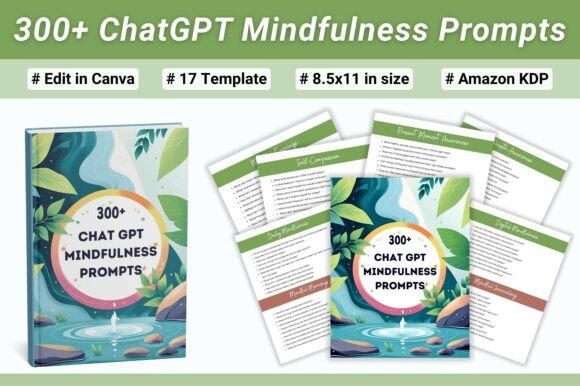
300 ChatGPT Mindfulness Prompts: A Practical Resource for Intentional Reflection
Amid rising demand for accessible, low-barrier mindfulness tools, 300 ChatGPT Mindfulness Prompts stands out—not as a standalone app or subscription service, but as a structured, reusable prompt library designed for integration into existing workflows. It’s not marketed as a replacement for therapy or clinical intervention, nor does it claim to “fix” stress or anxiety outright. Instead, it functions as a thoughtfully organized catalyst: 300 discrete, open-ended questions and reflections—grouped across 30 thematic clusters—that invite deeper attention to internal experience, habitual patterns, and moment-to-moment awareness.
What It Is—and What It Isn’t
This resource is a text-based collection, delivered in plain-language, ChatGPT-ready format. Each prompt is crafted to be self-contained, neutral in tone, and adaptable across contexts—whether pasted into an AI chat interface, copied into a digital journal, printed for workshop use, or read aloud during a guided pause. There are no proprietary algorithms, no tracking, no login, and no dependency on a specific platform beyond basic text input. Its value lies in curation, consistency, and clarity—not novelty or automation.
Unlike many AI wellness tools that prioritize speed or personalization at the expense of depth, 300 ChatGPT Mindfulness Prompts leans into restraint: prompts avoid leading language, prescriptive outcomes, or psychological jargon. For example, instead of “Write about how you’re failing at self-care,” a typical entry reads: “What sensation did you notice first when you paused just now? Where was it located? Did it shift when you breathed?” That specificity supports embodied awareness without interpretation.
Strengths in Practice
The collection’s most tangible strength is its thematic architecture. The 30 categories—including “Noticing Physical Sensation,” “Observing Thought Patterns,” “Gratitude Without Comparison,” and “Responding vs. Reacting”—provide scaffolding for progressive exploration. Users aren’t left to improvise structure; they can rotate through themes weekly, return to foundational ones during high-stress periods, or focus intensively on one area (e.g., “Boundaries & Energy Awareness”) for several days.
Real-world usability is reinforced by design choices: prompts are concise (most under 25 words), avoid assumptions about belief systems or lifestyle, and omit time-intensive instructions. One educator reported using a single prompt—“What’s one thing your body asked for today that you didn’t give it?”—as a 90-second classroom reflection before a midday lesson. A freelance developer integrated five prompts into a Notion template, rotating them daily to interrupt task-switching fatigue.
Consistency matters here. Unlike generative AI responses—which vary with model updates or phrasing—these prompts remain stable. That reliability supports habit formation: when the question stays the same across weeks or months, subtle shifts in answers become visible evidence of changing awareness.
Flexibility Without Friction
Its adaptability extends beyond format. Therapists have embedded prompts into intake forms to surface client metaphors (“If this feeling had a color and texture, what would it be?”). Coaches use them as warm-up questions before sessions, reducing reliance on generic “How are you?” Small business owners print subsets for team check-ins, selecting prompts aligned with current operational rhythms—e.g., “What’s one assumption you’re holding about this project that hasn’t been tested?” during planning phases.
Digital-native users benefit from copy-paste efficiency. Because each prompt is self-sufficient, there’s no need to load a dashboard or navigate menus. Paste one into ChatGPT, Claude, or even an email draft—and receive a grounded, non-judgmental response that models reflective listening. Over time, users report increased fluency in naming emotions and recognizing cognitive loops—not because the tool “teaches” those skills, but because repetition builds neural familiarity.
Who Benefits Most—and When
This resource serves people who already recognize the value of reflection but struggle with initiation or direction. It’s especially useful for:
- Professionals managing cognitive load: Marketers reviewing campaign performance, educators preparing for parent conferences, or engineers debugging complex systems—all benefit from brief, structured pauses that reset attentional bandwidth.
- Content creators and writers: Who face creative blocks tied to self-criticism or perfectionism. Prompts like “What would ‘enough’ look, sound, or feel like in this draft?” gently disrupt all-or-nothing thinking.
- Educators and facilitators: Seeking inclusive, secular, non-prescriptive material for student well-being initiatives or staff development—without requiring training or licensing.
- Individuals in early-stage mental wellness practice: Those hesitant about formal meditation or journaling find lower friction in responding to a single, concrete question than sustaining open-ended writing.
It’s less suited for users seeking real-time biofeedback, crisis support, or diagnostic guidance. Nor does it replace therapeutic dialogue when deep-seated patterns require relational attunement. Its role is preparatory, reinforcing, or complementary—not definitive.
Practical Considerations and Limitations
Quality hinges on user engagement, not passive consumption. Like a well-designed musical scale, the prompts offer structure—but expression depends on the player. Some users initially expect AI-generated insights to “solve” their stress; instead, they receive reflections that mirror back their own language and assumptions. That can feel underwhelming until the pattern of noticing itself becomes the point.
Presentation is functional rather than decorative. There’s no mobile app, audio narration, or illustrated workbook—though users frequently adapt it into those formats themselves. Print-friendly formatting means it works well in PDF planners, but it lacks built-in progress tracking or analytics. Long-term value emerges through reuse: returning to the same prompt after six weeks often reveals shifts invisible in real time—changes in vocabulary, pacing, or willingness to sit with discomfort.
One limitation worth noting: while prompts avoid cultural or spiritual prescriptiveness, some themes (e.g., “Self-Compassion in Action”) assume baseline safety and agency. Users experiencing acute distress, trauma activation, or severe burnout may need additional support before engaging deeply with certain reflections.
Making It Work for Your Context
Start small. Choose one theme—say, “Breath & Transition Points”—and use three prompts over three days. Notice whether responses feel repetitive, evasive, or revealing. If resistance arises, switch to a lighter category like “Everyday Beauty” or “Small Acts of Care.”
For teams or classrooms, assign rotating “prompt stewards”: one person selects and shares a prompt each morning via Slack or email. Keep responses optional and anonymous unless shared voluntarily. This lowers pressure while normalizing reflection as part of collective rhythm.
If integrating with AI tools, experiment with framing. Try prefacing a prompt with “Respond as a calm, experienced mindfulness guide—brief, grounded, no advice—just reflect back what’s present.” That often yields more useful output than raw prompting alone.
Ultimately, 300 ChatGPT Mindfulness Prompts earns its place not through innovation, but through quiet utility. It doesn’t promise transformation—it offers repetition, precision, and permission to pause. In a landscape crowded with quick fixes and algorithmic solutions, its enduring usefulness lies in what it refuses to do: rush, interpret, or override the user’s own pace of awareness.