Mindful Decluttering Workbook: A Practical Tool for Intentional Space Management
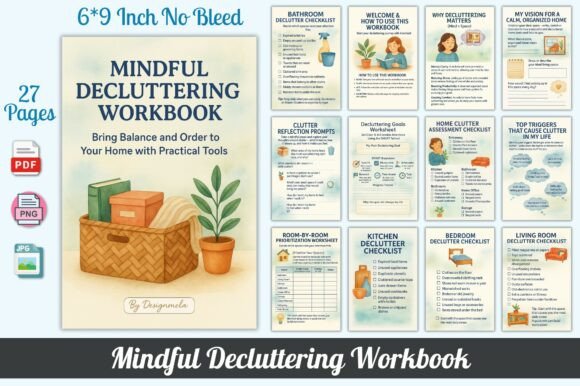
Decluttering isn’t just about removing objects—it’s about aligning your environment with your values, energy, and daily reality. The Mindful Decluttering Workbook approaches this work differently than most organizing tools: it treats clutter as a symptom, not the problem. Rather than prescribing rigid rules or demanding overnight transformation, it invites reflection, pacing, and self-awareness. This printable guide is designed for people who’ve tried quick fixes—like “one-toss-per-day” challenges or room-specific YouTube tutorials—only to find clutter returning within weeks. Its strength lies in bridging mindset and action through structured, adaptable worksheets.
What Sets the Mindful Decluttering Workbook Apart
Unlike digital apps that push notifications or physical planners with fixed timelines, the Mindful Decluttering Workbook is intentionally low-tech and self-paced. It’s a PDF you print and fill by hand—a format that supports deeper cognitive engagement. Research in cognitive psychology suggests handwriting activates neural pathways linked to memory and intentionality more consistently than typing. That’s relevant here: the workbook includes reflection prompts like *“What emotion do I associate with this drawer?”* or *“When did I last use this item—and was it out of need or habit?”* These aren’t rhetorical. They’re designed to interrupt autopilot decision-making, which is where most decluttering efforts stall.
The workbook also avoids prescriptive minimalism. It doesn’t assume your ideal space looks like a Scandinavian showroom or requires owning fewer than 50 items. Instead, its room-by-room checklists (kitchen, bathroom, office, kids’ spaces, garage) include flexible categories: *“Keep — but relocate,” “Use within 30 days,” “Donate if gently used,” “Recycle if nonfunctional.”* This acknowledges real-life constraints—like seasonal gear, sentimental items with family ties, or belongings tied to caregiving roles.
How It Compares With Other Approaches
Many people turn first to video-based methods—think popular decluttering series or influencer-led challenges. These offer visual inspiration and momentum, but often lack space for personal nuance. A 10-minute kitchen reset video won’t help you decide whether to keep your late grandmother’s chipped teacup collection. The Mindful Decluttering Workbook fills that gap: it doesn’t replace demonstration, but complements it with space for private processing.
Compared to habit-tracking apps (like Habitica or Streaks), the workbook trades automation for intentionality. Apps excel at reminders and streak counts—but they rarely ask *why* you’re decluttering a specific shelf or how that action connects to broader life goals. The built-in SMART goal planner in the Mindful Decluttering Workbook guides users to define objectives like *“Reduce countertop items in the kitchen to three functional tools by June 15”*—with space to note potential obstacles (“kids leave snacks out”) and support strategies (“add a labeled bin near the fridge”).
Physical planners and bullet journals offer flexibility, but require significant setup time and consistent discipline to maintain. The Mindful Decluttering Workbook reduces that friction: worksheets are pre-formatted, dated trackers are optional (blank or pre-filled), and the 30-Day Challenge includes realistic daily tasks—like *“Sort one junk drawer drawer”* or *“Review expiration dates in pantry cabinet”—not “declutter entire basement.”* That granularity matters, especially for busy parents, remote workers, or those managing chronic fatigue.
Strengths and Realistic Tradeoffs
Strengths:
- Adaptable pacing: No deadlines are enforced—users choose whether to follow the 30-Day Challenge linearly, jump between rooms, or pause for weeks without losing structure.
- Emotional scaffolding: The discard log includes columns for “reason for letting go” and “how this supports my current season”—helping users process loss or guilt without judgment.
- Practical integration: Time-blocking sheets pair decluttering with existing routines (e.g., “20 minutes after morning coffee”), reducing the mental load of “finding time.”
- Bonus resources: Natural cleaning hack sheets and supply checklists reduce the likelihood of buying duplicates mid-process—a common frustration when starting fresh.
Tradeoffs to consider:
- It’s a printable—not an app—so it requires access to a printer and physical storage space for completed pages.
- No community or coaching component: progress is self-monitored, which suits independent learners but may feel isolating for those who thrive on accountability partners or group motivation.
- While inclusive of diverse living situations (rentals, multi-generational homes, small apartments), it doesn’t include specialized modules for neurodivergent needs—like sensory-friendly sorting strategies or executive function adaptations.
When the Mindful Decluttering Workbook Fits Best
This resource works well when your primary barrier isn’t knowledge—it’s consistency, clarity, or confidence. For example:
- A teacher who clears her classroom desk weekly but can’t sustain order at home because systems feel “too rigid” may benefit from the workbook’s emphasis on *personal definitions* of “enough” and “accessible.”
- A new parent overwhelmed by baby gear accumulation might use the “Kids Room” checklist not to eliminate items, but to identify what’s truly needed *now* versus stored for later—then log decisions with notes like “Keep stroller base; donate bassinet (baby outgrew at 4 months).”
- Someone downsizing before a move may rely heavily on the Discard Log + Time Block Sheet to coordinate donation pickups, label boxes mindfully, and avoid last-minute panic sorting.
It also serves as a strong foundation before investing in larger organizing systems—like custom closet builds or smart storage solutions. Understanding *what you actually use*, *how often*, and *where friction occurs* makes those later purchases more purposeful.
When Another Option Might Be More Suitable
If your main challenge is visual or spatial reasoning—like arranging furniture in a tiny apartment or optimizing vertical storage—the Mindful Decluttering Workbook provides context but not design guidance. In those cases, pairing it with a floor-planning tool or consultation with a certified professional organizer adds practical dimension.
For individuals managing anxiety, ADHD, or depression, the workbook’s reflective prompts may feel emotionally heavy without external support. A therapist or coach trained in behavioral activation could help navigate those sections safely. Similarly, if digital accessibility is essential (e.g., screen reader compatibility, adjustable font size), a printable PDF has inherent limitations compared to responsive web tools.
And while the workbook supports gradual change, it’s not optimized for urgent scenarios—like preparing a home for sale in under two weeks. In time-critical situations, targeted, high-impact actions (e.g., “clear all surfaces in living room and master bedroom for staging photos”) may require faster, less reflective frameworks.
Making a Grounded Choice
Choosing a decluttering resource isn’t about finding the “best” one—it’s about matching method to your current capacity, goals, and learning style. The Mindful Decluttering Workbook stands out for its balance of structure and openness, its grounding in behavioral awareness, and its respect for complexity. It assumes clutter has layers—practical, emotional, habitual—and offers tools to address each without oversimplifying.
Before purchasing, consider printing one sample page—like the reflection prompt for “Why does this drawer stay messy?”—and completing it honestly. If the questions resonate, if the layout feels manageable rather than overwhelming, and if the tone feels supportive rather than prescriptive, it’s likely aligned with your needs. If not, that’s useful data too: sometimes the clearest sign of fit is noticing what *doesn’t* land—and using that insight to explore alternatives with equal care.