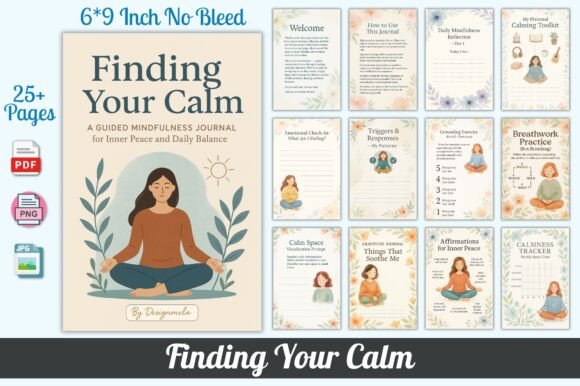
Finding Your Calm
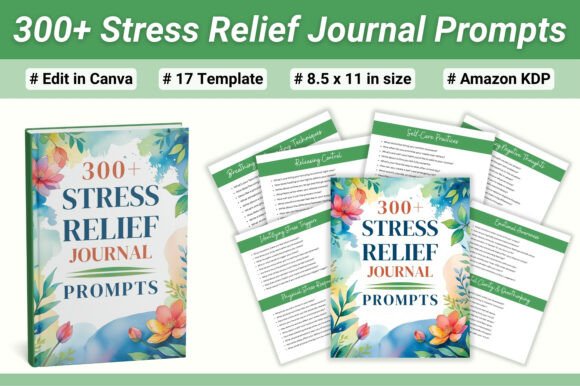
Ever caught yourself scrolling mindlessly at 10:47 p.m., heart racing over an email you’ll reply to tomorrow—or worse, never? Or sat through a team meeting while your inner voice spiraled about deadlines, miscommunications, and whether you remembered to mute yourself? You’re not broken. You’re human—running on mental bandwidth stretched thin by constant input, shifting priorities, and the quiet pressure to “have it all together.” Finding Your Calm isn’t another productivity hack or spiritual detox. It’s a grounded, printable guided journal built for real life—not ideal life.
This isn’t about adding one more thing to your to-do list. It’s about carving out 5–12 minutes where your nervous system gets permission to land. Whether you're a freelance graphic designer juggling three clients and a toddler, a high school teacher resetting between back-to-back classes, or a small business owner reviewing cash flow after a stressful vendor call—Finding Your Calm meets you where your breath catches, your shoulders rise, or your thoughts loop.
Where It Fits (Without Fitting In)
You don’t need a meditation cushion, silence, or even 20 uninterrupted minutes. People use Finding Your Calm in places that surprise them: folded open on a coffee shop table between client calls; tucked into a therapy notebook during a session break; clipped to a clipboard in a kindergarten classroom during lunch prep; or printed double-sided and slipped into a laptop sleeve for airport layovers.
A marketing manager told us she uses the Breathing Space Pages right before logging into Zoom for leadership syncs—just two minutes of intentional inhale-hold-exhale while tracing the gentle line art on the page. No app notifications. No audio. Just her hand moving slowly across paper, syncing breath with motion. That tiny ritual shifts her from reactive to responsive—not perfectly, but enough to ask better questions and listen longer.
For educators, the Emotional Check-Ins aren’t just self-care—they’re professional calibration. One middle school counselor prints a fresh gratitude moment page each Monday and leaves it on her desk. When a student walks in overwhelmed, she’ll quietly slide it over and say, “What’s one thing that felt steady today?” It opens space without demanding vulnerability—and often, it’s the first step toward deeper conversation.
How Different People Use It—Differently
Freelancers & creators: The Mindfulness-Based Prompts help untangle creative blocks rooted in fear—not lack of ideas. A copywriter used the “What’s really underneath this resistance?” prompt before starting a pitch she’d avoided for three days. She wrote, “I’m scared my voice sounds too soft for this brand”—and then, in the next box, “What if softness is the exact thing they need?” That shift didn’t just get the draft written—it landed the contract.
Therapists & coaches: Many integrate pages directly into sessions—especially the Self-Regulation Thought Awareness Tools. Instead of asking, “What were you thinking?” they hand clients the journal and point to the “Label the emotion + name one physical sensation” section. Clients report it feels less clinical, more collaborative—and therapists notice richer data emerging faster than in verbal-only processing.
Small business owners: The compact 6 × 9 format means it lives in the same drawer as receipts and supplier contracts. One bakery owner uses the Gratitude Moments log every Friday afternoon—not for positivity, but pattern-spotting. After four weeks, she noticed her calm spiked when she delegated packaging to her part-time staff. That insight led to restructuring her Saturday workflow—and cutting weekend burnout by 60%.
Students & lifelong learners: It’s not just for “stressed adults.” A college senior studying nursing used the sensory check-in prompts before clinical rotations. “I’d sit in the break room, close my eyes, and name five things I could see, four I could touch… It wasn’t magic—but it dropped my pulse enough that I stopped fumbling with IV tubing on my first try.”
What to Consider Before You Begin
This journal works best when treated like a tool—not a test. You don’t have to fill every page. You don’t need beautiful handwriting. In fact, some users scribble answers in the margins, cross out prompts that don’t resonate, or skip ahead to the breathing page when words feel impossible. That’s not failure—that’s attunement.
If you’re new to journaling, start with just the Pause Prompt on page one: “What’s one thing your body is asking for right now?” Answer in one word. Do it three times this week. Notice what shows up—rest, water, stillness, movement, quiet. That’s your compass.
If you’ve tried mindfulness apps and felt alienated by cheerful voices and gamified streaks, Finding Your Calm offers something quieter: no login, no algorithms, no “wellness guilt.” Just paper, pen, and the unforced invitation to return—to your breath, your boundaries, your own pace.
And because it’s printable, you control the experience: print only what you need, bind it how you like, or keep it digital on a tablet with a stylus. One UX designer laminated her favorite breathing page and taped it inside her laptop lid—so it appears every time she opens her work device. Another uses the PDF on her e-ink reader at night, avoiding blue light while still honoring the ritual.
Real Calm Isn’t the Absence of Chaos
It’s the ability to feel your feet on the floor while chaos swirls. To notice tension in your jaw and soften it—not erase it. To hold space for uncertainty without rushing to fix it.
Finding Your Calm doesn’t promise peace forever. It offers something more reliable: a repeatable, portable way to find your center—even when everything else feels off-balance. Not by changing your circumstances, but by strengthening your capacity to meet them with clarity, kindness, and quiet resilience.
That’s why teachers keep it in their lesson-planning binder. Why therapists recommend it alongside CBT handouts. Why a software engineer prints a new copy every quarter—and leaves the old ones stacked, dog-eared, and honest on her shelf. Not as proof she’s “fixed,” but as evidence she keeps showing up—for herself, first.