Mindful Morning Habit Tracker
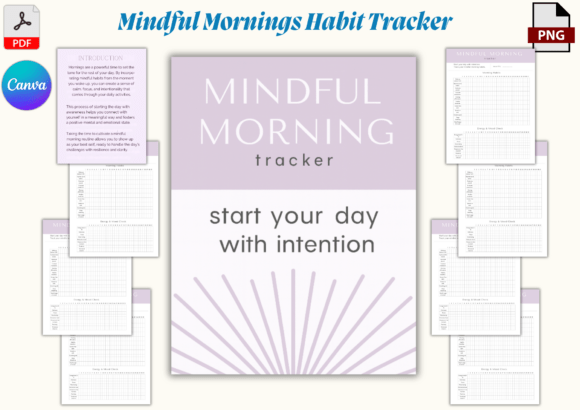
A well-designed morning routine isn’t about rigid schedules or performative productivity—it’s about creating intentional space where your values, energy, and priorities align before the day’s demands take over. The Mindful Morning Habit Tracker is built for that alignment: a 33-page printable wellness journal that supports deliberate habit formation through structure without rigidity, reflection without overwhelm, and consistency without self-punishment.
Why Strategic Consistency Starts Before 9 a.m.
For professionals managing multiple roles—freelancers juggling client work and personal projects, educators balancing lesson planning with emotional labor, small business owners navigating operations and marketing—the morning sets the cognitive and emotional bandwidth for everything that follows. Research in chronobiology and behavioral psychology shows that habits formed in low-cognitive-load windows (like early morning) embed more reliably than those attempted midday or after decision fatigue accumulates. But consistency only delivers value when it’s tied to outcomes—not just activity. That’s where the Mindful Morning Habit Tracker shifts from passive logging to active calibration.
It doesn’t ask you to “do more.” Instead, it surfaces patterns: Is your energy dip at noon linked to skipping hydration before 8 a.m.? Does your mood score drop on days when gratitude journaling is omitted—even if meditation time stays constant? These aren’t abstract insights. They’re operational data points you can act on—adjusting timing, sequencing, or emphasis based on what actually moves the needle for your focus, resilience, or creative output.
How It Fits Into Real-World Planning Systems
If you use Notion, Trello, or Asana for project management, the Mindful Morning Habit Tracker functions as your personal operating system’s “health layer.” It doesn’t replace task tracking—it informs it. For example:
- A blogger notices low motivation scores on mornings with no affirmations or goal visualization. She adjusts her pre-writing ritual to include just two minutes of written intention-setting—and sees a 22% increase in first-draft completion rate over three weeks.
- A wellness coach uses the daily emotional check-ins to spot recurring stress triggers (e.g., rushed wake-ups correlating with client session cancellations). She redesigns her own morning buffer time—and begins recommending similar micro-adjustments to clients with burnout patterns.
- A small business owner tracks calmness alongside weekly revenue metrics. Over two months, she identifies that days with consistent breathwork + hydration precede higher-quality client proposals and fewer revision rounds.
This isn’t anecdotal. It’s applied behavioral design: using observable inputs (wake-up time, hydration, mood rating) to test hypotheses about performance levers. The tracker’s minimalist layout prevents distraction; its structured prompts prevent vague self-assessment (“I felt fine”) in favor of actionable distinctions (“I felt grounded but fatigued—likely due to poor sleep onset, not caffeine”).
When—and When Not—to Use the Mindful Morning Habit Tracker
Use it when:
- You’re launching a new habit (e.g., daily meditation) and need objective feedback on adherence *and* impact—not just whether you did it, but how it affected your afternoon clarity or evening recovery.
- You’re refining an existing routine (e.g., shifting from reactive email-checking to intentional planning) and want to measure downstream effects on decision quality or meeting efficiency.
- You’re supporting others’ growth—coaches, team leads, educators—and need a non-clinical, accessible tool to model self-awareness and evidence-based adjustment.
Avoid relying on it when:
- Your goal is undefined. Tracking wake-up times matters only if you’ve decided earlier rising supports a specific outcome (e.g., uninterrupted deep work before 10 a.m.). Without that link, data becomes noise.
- You’re in acute transition—job loss, caregiving surge, health crisis. In high-stress periods, the tracker’s value flips: it should simplify, not add steps. Consider using only 1–2 pages (e.g., mood + one keystone habit) until stability returns.
- You treat it as a report card. The graphs and checkmarks are diagnostic tools—not moral measures. A “low” energy score isn’t failure; it’s information pointing toward sleep hygiene, nutrition timing, or boundary setting.
Design Choices That Enable Intentional Use
The Mindful Morning Habit Tracker avoids common pitfalls of habit journals. No guilt-inducing red X’s. No pressure to fill every box. Its clean, uncluttered layout reduces activation energy—the mental friction that stops people from opening a planner. The inclusion of transparent PNGs and an editable Canva template isn’t just about aesthetics; it’s about adaptability. You can:
- Overlay habit prompts onto your existing digital dashboard.
- Resize sections for specific needs (e.g., expand the gratitude prompt if that’s your current leverage point).
- Integrate brand colors or fonts if you’re a coach offering this as part of a client onboarding kit.
That flexibility matters strategically. A marketer testing messaging around “mindful productivity” can use the tracker’s visual language to reinforce tone—calm, precise, human-centered—across touchpoints. A publisher building a wellness-themed product suite can position it as the foundational tool before introducing advanced offerings (e.g., habit-coaching sessions or quarterly review templates).
Long-Term Value: From Tracking to Tuning
Most habit trackers plateau at month three. Engagement drops because they measure behavior, not evolution. The Mindful Morning Habit Tracker builds in natural progression: monthly habit trackers show streaks, yes—but the mood, energy, and motivation graphs reveal trends across seasons. You begin to see not just *what* you did, but *how your relationship to those actions changed*. Did affirmations feel rote in Week 1—and meaningful by Week 6? Did calmness scores rise not because you meditated longer, but because you shortened the session and added mindful walking instead?
This is where the tracker transitions from accountability tool to developmental instrument. For creators, that means identifying which rituals fuel original thinking versus maintenance-mode output. For decision-makers, it highlights when intuition is sharpest (e.g., after journaling vs. after scanning headlines). For educators, it surfaces correlations between personal grounding practices and classroom presence—data that can reshape professional development priorities.
Getting Started Without Overcommitting
Start with three questions—not tasks:
- What one outcome would make tomorrow measurably better? (e.g., “Fewer mid-afternoon crashes,” not “Be more energetic.”)
- Which morning action most directly influences that outcome? (e.g., “Drinking 12 oz water within 10 minutes of waking” has stronger physiological links to sustained alertness than generic “hydration.”)
- What’s the smallest version of that action I’ll actually do, even on high-friction days? (e.g., keeping a glass by the bed, so “drink water” requires zero decisions.)
Then use the tracker’s daily section for just that action—and the mood/energy graph. After 10 days, review. If the pattern holds (e.g., higher energy scores on hydrated days), add a second lever (e.g., 60 seconds of breathwork). If not, revise the hypothesis. This iterative approach mirrors how high-performing teams run experiments—not with grand launches, but controlled variables and clear success criteria.
Final Consideration: Your Context Is the Curriculum
No tool transforms mornings. People do—using tools with clarity, curiosity, and contextual awareness. The Mindful Morning Habit Tracker gives you structure to notice what matters *to you*, not what’s trending. It won’t fix systemic constraints (unrealistic deadlines, under-resourced teams, inequitable care loads). But it will help you identify where your agency truly lies—and how to deploy it with precision. That distinction—between what you control and what you influence—is the foundation of sustainable performance. Start there. Track honestly. Adjust deliberately. And let your mornings become less about getting ready for the world—and more about showing up, clearly, for what matters.